

On 1 November 2006, a 43-year-old man walked into a London hospital with abdominal pain, diarrhoea, and vomiting. He was treated for gastroenteritis. Three weeks later he was dead, and Scotland Yard was investigating a murder committed with a substance so rare in human poisoning that his clinicians had never seen a case. That man was Alexander Litvinenko, and the poison was polonium-210 — an element that kills through physics.
Most poisons work by interfering with a biochemical pathway: blocking an enzyme, jamming a receptor, uncoupling a membrane gradient. Polonium-210’s lethality comes almost entirely from what happens inside the nucleus of the atom, not the outer electron shell that determines ordinary chemical reactivity. To understand this, we need to set toxicology aside for a moment and look more closely at nuclear physics.
Polonium-210 is unstable. It decays by emitting an alpha particle - a helium nucleus, two protons and two neutrons bound together - together with an occasional low-yield gamma photon. The half-life is 138 days, and it decays to stable lead-206.
Because it is relatively large, slow (compared to other radiation), and carries a double positive charge, an alpha particle interacts strongly with anything it hits, transfering nearly all its energy within a few tens of micrometres. That transfer is described by a value called linear energy transfer, or LET - essentially, how much energy a particle deposits per unit distance travelled. A typical alpha particle from an emitter like polonium has an LET roughly 400 times higher than a beta particle (electron) of comparable energy.
High LET translates directly into biological damage. Sparse, low-LET radiation such as gamma rays or beta particles tends to produce isolated single-strand DNA breaks that a cell can usually repair. Dense, high-LET alpha radiation instead causes clusters of double-strand breaks packed close together, overwhelming repair processes and producing the kind of catastrophic, irreparable genomic damage that kills the cell or triggers malignant transformation. This is why radiation protection standards apply a weighting factor of roughly 20 to alpha radiation compared with 1 for gamma, beta, or X-rays; gray1 for gray of absorbed physical dose, alpha radiation is considered to be roughly twenty times more biologically damaging.
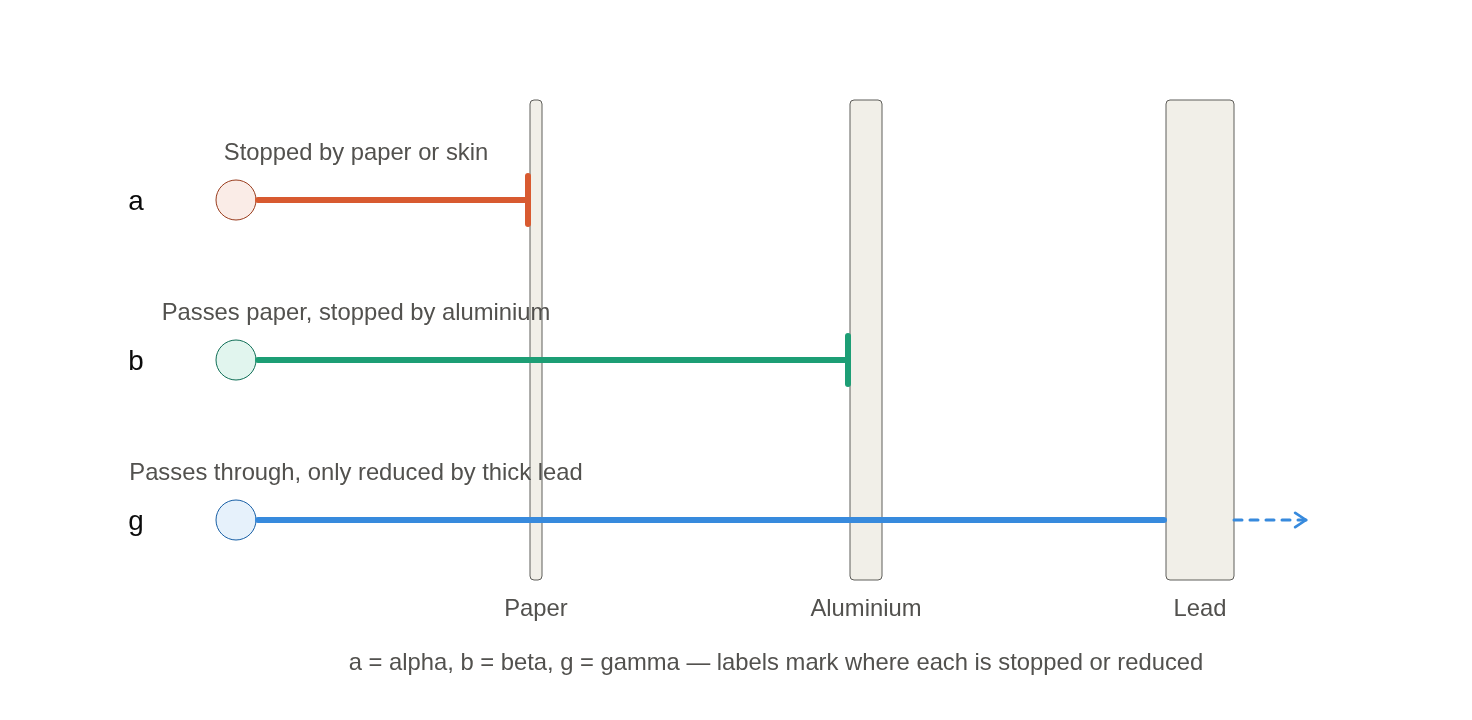
Alpha emitters are at the same time the least dangerous and the most dangerous form of ionising radiation, depending entirely on where they are. Outside the body, an alpha particle can’t even cross the dead outer layer of skin, a sheet of paper stops it completely. That lack of penetration is why polonium-210 is legally and commercially used, in tiny sealed quantities, as an anti-static device in industrial processes and film manufacturing, and why it triggers no alarm on a standard security scanner.
However, swallow, inhale, or otherwise internalise polonium 210, every particle now discharges its energy directly into living tissue, at a range too short to spread the damage out, with nothing between the decay and your DNA.
Once absorbed - via ingestion, inhalation, or a wound - polonium-210 concentrates first in red blood cells before redistributing over subsequent days to the liver, kidneys, spleen, bone marrow, gastrointestinal tract, and gonads. It is cleared slowly, through urine, bile, sweat and possibly breath, and is also deposited in hair, and has a biological half-life in the body of roughly 30 to 50 days - long enough, at a sufficient dose, to deliver a fatal cumulative radiation exposure over just a few days to weeks even though the isotope itself is being partly excreted the whole time.
The clinical picture reflects tissue distribution. Cells that divide rapidly - bone marrow, gut epithelium, hair follicles - are the most radiosensitive, so the syndrome that emerges is a fairly classic, if unusually severe and rapid, acute radiation syndrome:
Prodromal phase (hours to ~2 days): nausea, vomiting, anorexia, sometimes abdominal pain that can be mistaken for an acute abdomen or simple gastroenteritis.
Two days to ~2 weeks: progressive bone marrow suppression with falling platelets and neutrophils, along with mucositis and the beginnings of alopecia.
After two weeks: multi-organ deterioration as marrow failure, gastrointestinal breakdown, and direct organ radiotoxicity compound each other, frequently progressing to circulatory collapse and death.
Early symptoms are indistinguishable from a wide range of chemical toxins and from ordinary infective gastroenteritis, so without a high index of suspicion the diagnosis is easy to miss. Further, a standard Geiger counter run over the patient’s body will typically find nothing, because the alpha particles the polonimu emits can’t escape the tissue they’re embedded in to reach a detector outside the skin.
In the Litvinenko case, thallium poisoning was seriously entertained and only ruled out when blood thallium levels came back below toxic thresholds. The diagnosis was ultimately made by gamma-ray spectroscopy of a urine sample, picking up the incidental 803 keV gamma photon that accompanies a fraction of polonium-210 decays. The alpha decay does the damageg, but it is the gamma emission that gives the poison away analytically.
Whole-body counting and 24-hour urine or faecal radioactivity assays are the mainstay of confirming internal contamination once it’s suspected, and dose reconstruction can be performed retrospectively from measured tissue and excretion levels.
The practical lesson for any clinician: an unexplained gastrointestinal prodrome followed by progressive bone marrow failure and alopecia over the following one to three weeks should prompt consideration of radionuclide poisoning, however implausible it initially seems, because the initial presentation gives almost no other clue.
There is no way to reverse alpha-induced DNA damage once it has occurred; deposited energy has already done what it’s going to do at the moment of decay. Management is therefore aimed at reducing further internal redistribution and retention, alongside supportive care for the resulting marrow failure and organ dysfunction.
Dimercaprol (British Anti-Lewisite), with penicillamine as an alternative, is the chelating agent currently recommended for polonium-210 poisoning, on the basis of both limited clinical experience and animal data; other chelating agents have shown promise experimentally but lack the same evidence base.
Beyond chelation, treatment is essentially the ICU management of acute radiation syndrome - transfusion support, infection prophylaxis in the face of neutropoenia, and organ support as multi-organ failure develops. The outcome is ultimately decided by the size of the internalised dose rather than by anything the treating team can do to intervene in the underlying mechanism.
Polonium-210 is a reminder that poisoning doesn’t always involve molecules binding receptors. Sometimes the poison is a physical process - energy deposited at a very short distance, from a source inside the body - and the entire clinical and diagnostic picture, from the unremarkable prodrome to the false-negative Geiger counter, follows directly from the physics of polonium decay, and the penetration and energy transfer of alpha particles.
---
This piece is intended as a clinical and physiological review, not a comprehensive toxicology reference. Anyone managing a suspected case should consult national radiation protection and public health authorities immediately - in the UK, that means the UK Health Security Agency’s radiation, chemical and environmental hazards service.
Further reading
Nathwani AC, Down JF, Goldstone J, Yassin J, Dargan PI, Virchis A, Gent N, Lloyd D, Harrison JD. Polonium-210 poisoning: a first-hand account. Lancet. 2016 Sep 10;388(10049):1075–1080. doi:10.1016/S0140-6736(16)00144-6. The treating team’s own account of the Litvinenko case - the primary source for the clinical timeline in this article.
Harrison J, Leggett R, Lloyd D, Phipps A, Scott B. Polonium-210 as a poison. J Radiol Prot. 2007;27(1):17–40. doi:10.1088/0952-4746/27/1/001. Dosimetric and toxicokinetic evaluation of human and animal data, published shortly after the Litvinenko case.
Jefferson RD, Goans RE, Blain PG, Thomas SHL. Diagnosis and treatment of polonium poisoning. Clin Toxicol (Phila). 2009 May;47(5):379–392. doi:10.1080/15563650902956431. Review covering diagnosis and the chelation evidence base referenced above.
Leggett RW, Eckerman KF. A systemic biokinetic model for polonium. Sci Total Environ. 2001;275:109–125. The organ-distribution and retention model underlying the toxicokinetics summarised above.
Scott BR. Health risk evaluations for ingestion exposure of humans to polonium-210. Dose Response. 2007;5(2):94–122. Dose-response modelling for oral polonium-210 exposure.
McFee RB, Leikin JB. Death by polonium-210: lessons learned from the murder of former Soviet spy Alexander Litvinenko. Semin Diagn Pathol. 2009;26(1):61–67. Covers the forensic and medico-legal dimensions of the case.
ICRP Publication 103. The 2007 Recommendations of the International Commission on Radiological Protection. Ann ICRP. 2007;37(2–4). Source of the radiation weighting factor (w_R = 20 for alpha particles) referenced in the LET/RBE discussion.
Le MH. Polonium 210, exposed. J Med Toxicol. 2007 Jun;3(2):82–84. doi:10.1007/BF03160913. A short, clinically oriented commentary published in the immediate aftermath of the case.
Hall EJ, Giaccia AJ. Radiobiology for the Radiologist. Wolters Kluwer. Standard textbook treatment of LET and RBE, and the mechanistic basis for clustered DNA damage from high-LET radiation, for readers wanting the underlying cell biology in more depth.
The gray (Gy) is the SI unit for the absorbed dose of ionising radiation. One gray indicates one joule of energy is absorbed per kilogram of matter. 1 Gy = 100 rad.